
Waterproof vs. Water-Resistant: What the Labels Actually Mean
On a showroom shelf, “waterproof” and “water-resistant” look like the same promise with one word changed. They are not. That single word decides how your floor holds up to a spilled glass, a slow appliance leak, or a pet accident, and it can be the difference between wiping up a puddle and replacing a room. Here is what each label actually protects, where each one belongs in a Four Corners home, and why the way a floor is installed matters more than the marketing on the box.
What “waterproof” actually means
Waterproof is a claim about the material. The core of the plank is made from something that does not absorb water, usually a rigid stone or plastic core in luxury vinyl plank, or the dense body of a porcelain tile. Because the core is non-organic, standing water does not make it swell, warp, or come apart. You could set a waterproof plank in a bucket of water, pull it out days later, dry it off, and it would be unchanged.
That is why waterproof flooring is the go-to for kitchens, bathrooms, laundry rooms, entryways, and any space where water is a regular visitor. The plank itself simply is not bothered by it.
What “water-resistant” actually means
Water-resistant is a claim about time. A water-resistant floor, which covers most traditional laminate, the newer water-resistant laminate lines, and some engineered woods, is built to repel moisture for a limited window. Manufacturers commonly rate that window somewhere between 24 and 72 hours, though it varies by product. A protective surface coating and tight seams buy you time to catch a spill before it gets in.
The catch is what happens when a spill is not caught. Left sitting, or fed by a slow leak you cannot see, water eventually works past the coating and into the core. In laminate that core is a wood-based board, and once it takes on water it swells, the seams start to peak, and the boards can delaminate. Water-resistant flooring rewards attention and punishes standing water.
The part the label leaves out
Here is the point most homeowners miss, and the one worth slowing down for: both words describe the plank, not your floor.
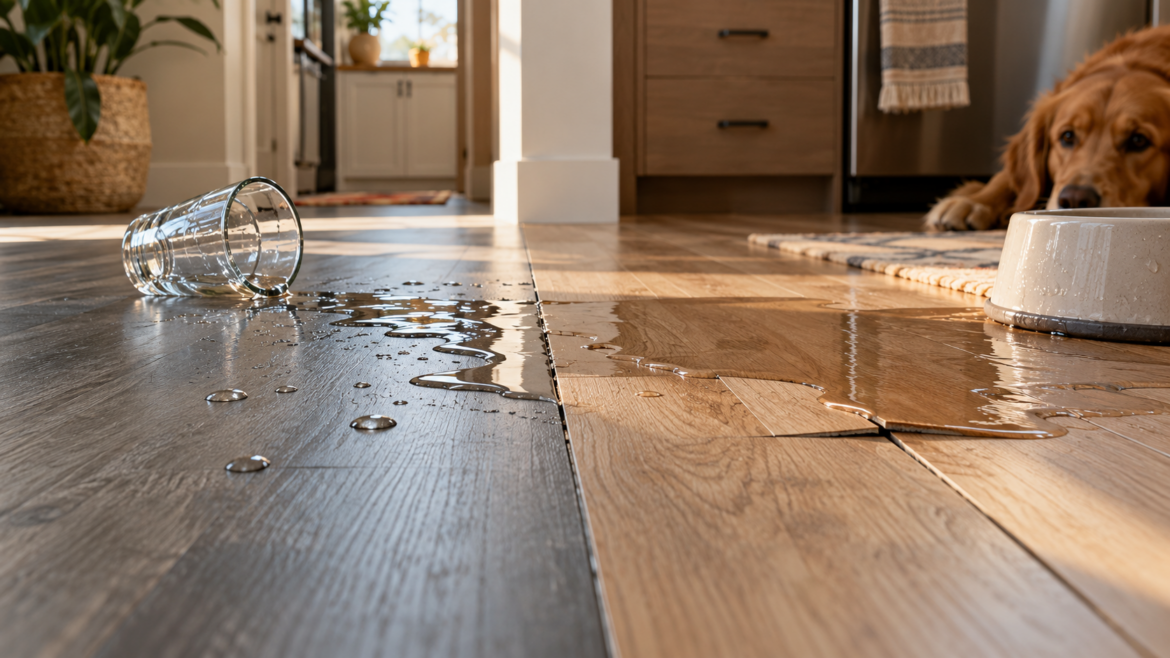
A waterproof plank does not make a waterproof floor. Water that lands on the surface can still travel down through the seams and around the edges to the subfloor underneath, especially if the perimeter and transitions were not sealed and no moisture barrier was used. The board stays fine. The subfloor and the structure may not.
This is why manufacturers are careful with their warranties. Even a floor sold as waterproof is almost never covered against floods, overflowing dishwashers and washing machines, failed water heaters, or sewage backups. Waterproof is not floodproof. The honest way to read the label is this: the word on the box protects the board, and the installation protects the house.
Why this matters more over a concrete slab
Most homes in Farmington, Bloomfield, Aztec, and Kirtland are built slab-on-grade, and that changes the moisture math. When water slips past the seams of a floor laid over concrete, it does not soak away into a crawl space. It sits on the slab. On top of that, a concrete slab can push its own moisture upward from the ground below, which is a separate problem the plank rating does nothing to solve.
What actually keeps a slab-based floor dry is the assembly under it: sealed edges and transitions, the right moisture barrier or underlayment, and an installer who tests the slab before anything goes down. If you want the full picture on getting this right, our guide to flooring over a concrete slab walks through the whole system.
The dry-climate reality check
It is fair to wonder whether waterproof flooring is overkill in a place as dry as the Four Corners. Our low humidity does take one moisture source off the table. But the risks that matter here were never about humidity. They are point sources: a kitchen sink, a shower, a washer hose, a pet accident, and slab moisture rising from below. Those happen in a dry climate exactly as often as anywhere else.
One honest caveat on pets while we are here. Waterproof is not urine-proof. The acid and ammonia in pet urine can stain and damage over time even when the plank shrugs off the water itself, so clean up accidents quickly no matter what your floor is rated.
So which do you actually need?
You do not have to buy the most expensive floor for every room. Match the floor to how water reaches the space:
- Choose waterproof for kitchens, bathrooms, laundry and mud rooms, entryways, and any home with pets or young kids making regular spills.
- Water-resistant is usually fine for bedrooms, living rooms, home offices, and other low-moisture rooms, and it often costs less.
Matching the rating to the room is how you get the protection you need without paying for protection you do not.
What to check before you buy
- Read the warranty, not just the box. Look at which water events are covered and for how long. That fine print tells you more than the headline label does.
- Ask for the exact spill-time rating on any water-resistant product, so you know the real window you are working with.
- Confirm the install details. Ask whether your installer will seal edges and transitions and use the correct moisture barrier over your slab. This is the step that turns a waterproof plank into a floor that actually keeps water out.
- Be honest about the room. Think through the real spills, leaks, and traffic that space will see over the years, then choose for that reality rather than the best case.
The word on the box is a starting point, not a guarantee. The right floor for the room, installed as a sealed system over a properly prepared slab, is what keeps water where it belongs. If you want help matching floor to room and making sure the assembly is right for your home, reach out and we will take a look in person.