
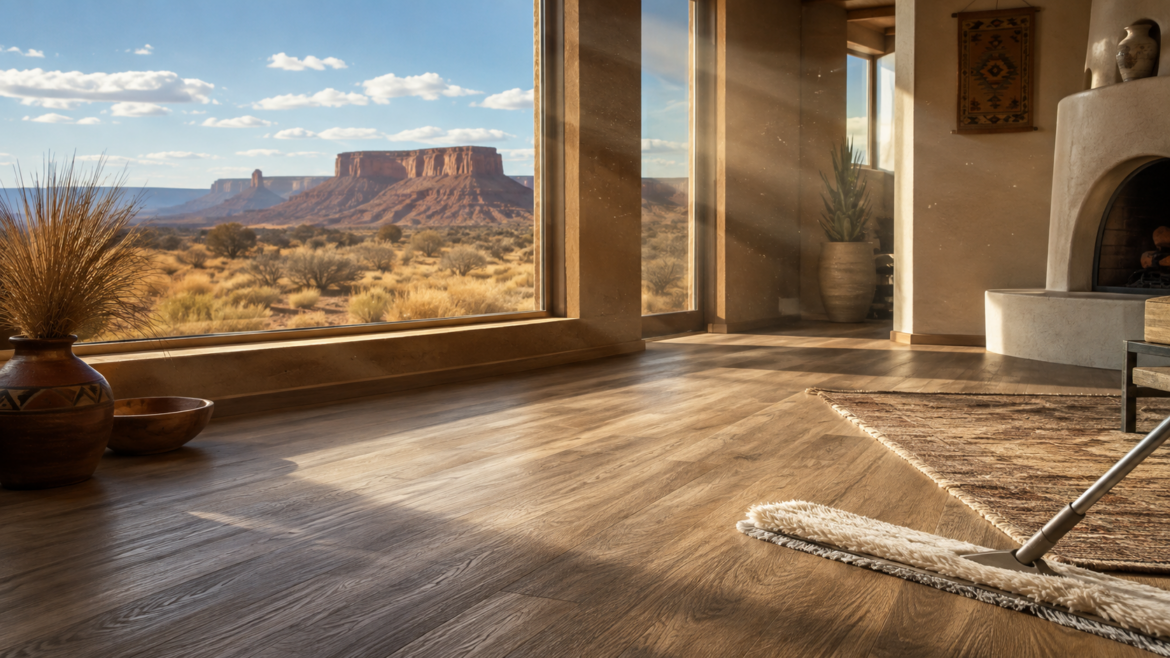
Dust, Sun, and Dry Air: A Four Corners Guide to Protecting Your Floors
How to Protect Floors in a Dry Climate – A floor that would last decades in a mild, humid climate has a harder job here. The same high desert that gives us those big skies and dry, comfortable summers is quietly working against the floors inside your house. Fine grit scratches. Relentless sun fades. Dry air pulls boards apart. None of it happens overnight, which is exactly why so many homeowners never connect the wear to the cause.
The good news is that almost all of it is preventable, and most of the prevention costs very little. This is the homeowner’s playbook for keeping your floors looking new across Farmington, Bloomfield, Aztec, and Kirtland. We will go enemy by enemy, because each one calls for a different habit.
Enemy number one: grit and fine sand
If you could see your floor’s finish under a microscope after a dusty week, you would find thousands of tiny scratches. Out here, the dust is not soft house dust. It is fine mineral grit, and it behaves like sandpaper underfoot. Every step grinds it into the finish, and over a season that dulls the sheen and wears through the protective layer.
Grit is the single biggest threat to a floor’s finish in this region, and it is also the easiest to control.
Catch it at the door. The majority of tracked-in grit drops in the first several steps inside. Put a coarse mat outside every entry and a second, absorbent mat just inside. Bigger is better here. A short mat only catches one or two footfalls; a long runner catches the whole approach.
Go shoes-off where you can. Even a shoes-off zone by the main door makes a real difference, especially after time spent outdoors.
Sweep smart, not hard. Reach for a microfiber dust mop, not a stiff broom. A stiff broom drags grit across the surface and can scratch as much as it clears. When you vacuum, use the hard-floor setting and switch the beater bar off, because those spinning bristles fling grit and can chip edges.
Mind the felt pads. Furniture pads are your friend, but grit embeds in them over time and turns them into sanding blocks. Check them every few months and swap out any that feel gritty or have worn thin.
Trim the pets. Dog nails are one of the most common sources of surface scratches. Keeping them trimmed protects both hard floors and your dog’s traction.
Enemy number two: the sun
We get a lot of sunshine, and sunshine fades floors. Direct light will lighten or yellow hardwood, wash out the color in some vinyl and laminate, and fade carpet over time. The sneaky part is that it fades unevenly. Pull up a rug or move a couch after a year and you will often see a sharp line where the covered floor kept its original color and the exposed floor did not.
Rotate and rearrange. Every few months, shift area rugs and move furniture slightly so no single strip of floor takes all the sun all the time. Even small changes even out the fading.
Filter the light. Sheer curtains, cellular shades, or UV-filtering window film all cut the ultraviolet load without darkening the room completely. Window film is an easy weekend project and does the most work per dollar on your sunniest windows.
Close up during peak hours. On south and west-facing rooms, dropping the blinds during the harshest midday and afternoon sun goes a long way over a summer.
Choose with fade in mind. If you are shopping for new flooring, fade resistance varies a lot by product. Our guide to waterproof luxury vinyl plank flooring covers wear layers, and our engineered versus solid hardwood comparison is worth a read if a sunny room is in the plan.
Enemy number three: dry air
This one surprises people. Our humidity runs low most of the year and drops even lower in winter when the heat is running. Wood is hygroscopic, meaning it gives up moisture to dry air and shrinks as it does. That is why thin gaps can open up between hardwood boards in the coldest months, then quietly close again when the air warms up in spring.
Do not panic over seasonal gaps. A hairline gap that appears in January and closes by May is normal seasonal movement, not damage. Rushing to fill it in winter usually causes problems when the wood expands again.
Add a little humidity in winter. Many wood floor manufacturers are happiest when indoor humidity stays in a moderate range, often somewhere around 35 to 55 percent. A humidifier during the driest months keeps boards more stable and your sinuses happier too.
Let new flooring acclimate. Whenever flooring is delivered, it needs to sit in the room and adjust to your home’s conditions before it goes down. Skipping that step in a dry climate is asking for movement later.
Lean toward stable products in dry rooms. Engineered wood and quality rigid vinyl handle our humidity swings far better than solid hardwood, which is one more reason engineered is so often the right call over a slab.
The quiet enemy underneath: slab moisture
Most homes here sit on a concrete slab, and while dry air is the story above your floor, moisture rising through the slab is the story below it. It is invisible, it does not care how dry the air is, and it is a leading cause of floors failing from underneath. Before any new floor goes down, the slab should be tested. We cover the whole process in flooring over a concrete slab, which is worth reading before you commit to materials.
Everyday habits that add years
A handful of small routines protect any floor, in any room.
Wipe spills quickly, even on floors labeled waterproof. Waterproof protects the surface, but water sitting at seams and edges can still find the subfloor.
Use the right cleaner. Match the cleaner to the floor. Harsh or overly wet mopping dulls finishes and can seep into seams. A barely-damp microfiber and a product made for your floor type is almost always the answer.
Protect against furniture. Felt pads under legs, wide caster cups under heavy pieces, and a lift-do-not-drag rule when you rearrange.
Put down rugs in the war zones. Entryways, kitchen sink areas, and hallways take the most traffic. A washable rug in those spots absorbs the wear so your floor does not.
The honest bottom line
You do not need to baby your floors to make them last out here. You need a mat at the door, a little shade on the sunniest windows, a humidifier in the dead of winter, and the good sense to test a slab before you build on it. Those few habits are the difference between a floor that looks tired in five years and one that still looks new in fifteen.
If you are weighing new flooring and want something built to shrug off dust, sun, and dry air from the start, that is a conversation we have with Four Corners homeowners every week. We are glad to point you toward what actually holds up here.